



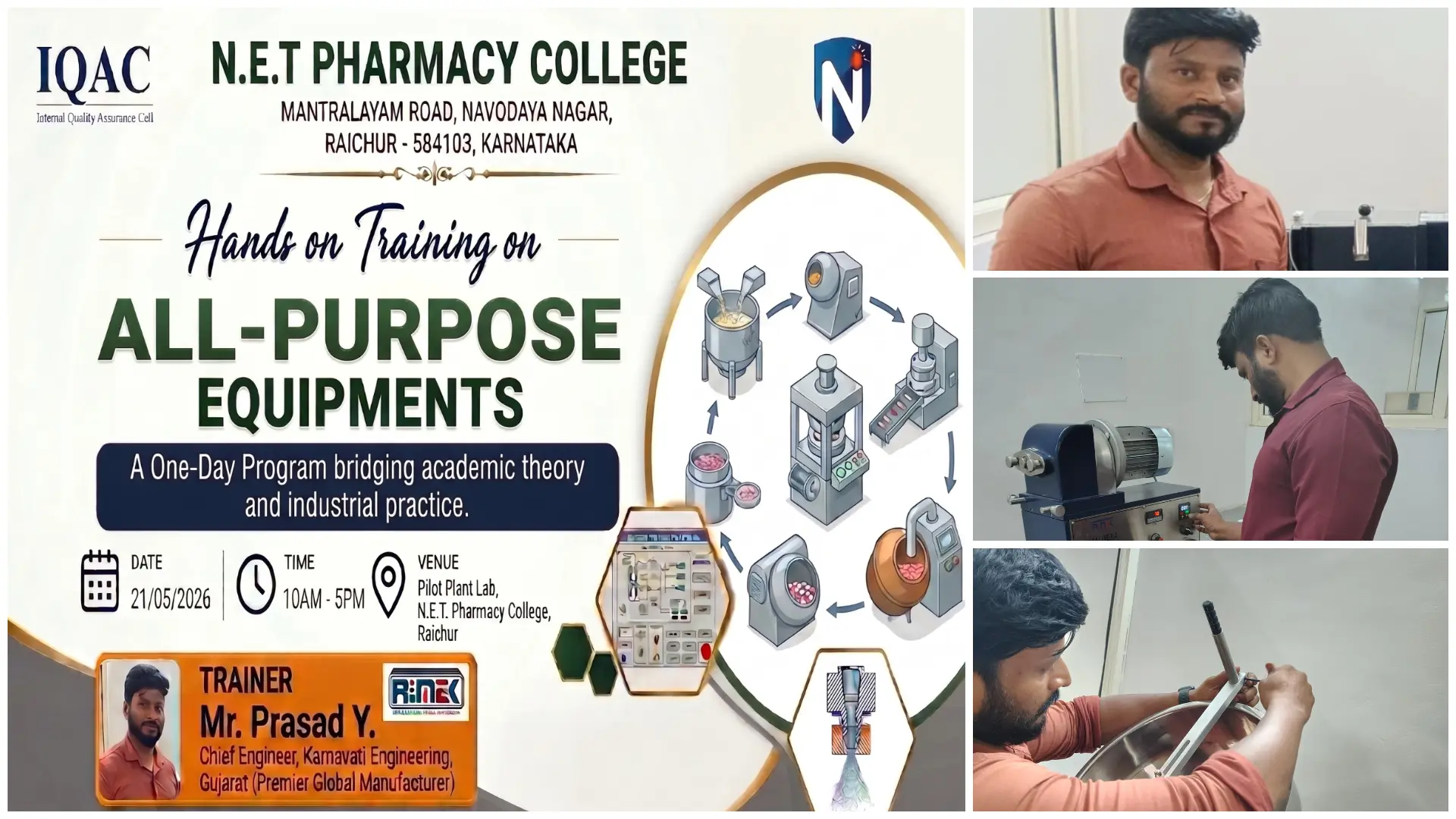

Faculty Members of N.E.T. Pharmacy College Participate in Hands-on Training on All-Purpose Pharmaceutical Instruments
N.E.T. Pharmacy College, Raichur, organized a hands-on training program on the operations and maintenance of all-purpose pharmaceutical instruments with the objective of enhancing technical competency and providing practical exposure to equipment commonly used in pharmaceutical manufacturing and quality control laboratories.
The training program was coordinated by Dr. Sarfaraz Md. Faculty members including Dr. A. Rajesh Pavan, Dr. Pradnya Patil, Mr. Viswanath H. A., and Mr. Rohit Bhandari actively participated in the session.
The resource person for the program was Mr. Prasad Y., Chief Engineer, Karnavati Engineering, Gujarat, a leading global manufacturer of pharmaceutical formulation machinery. With his extensive industrial experience and technical expertise, he provided valuable insights into the operation, maintenance, and troubleshooting of various pharmaceutical instruments.
The primary objective of the training was to bridge the gap between academic knowledge and industrial practice by providing direct exposure to engineering principles, operational procedures, and maintenance practices associated with pharmaceutical equipment. The program aimed to strengthen the practical understanding of faculty members, enabling them to effectively transfer industry-relevant knowledge to students.
The training session was highly interactive and systematically structured into machine overviews, live demonstrations, operational procedures, and maintenance workflows. Mr. Prasad guided the participants through the working principles, calibration requirements, safety precautions, and preventive maintenance practices of several all-purpose laboratory and pharmaceutical instruments.
The faculty members received practical training on equipment such as sieve shakers, blenders, mixers, and other commonly used pharmaceutical processing instruments. Detailed explanations were provided regarding equipment handling, performance optimization, troubleshooting techniques, and routine maintenance protocols to ensure efficient and safe operation.
The resource person also highlighted the importance of equipment qualification, process consistency, and adherence to Good Manufacturing Practices (GMP) in pharmaceutical industries. Participants were given the opportunity to interact directly with the machinery, observe operational parameters, and clarify technical queries related to industrial applications.
The program served as an excellent platform for faculty development by enhancing technical skills and fostering a deeper understanding of pharmaceutical manufacturing equipment. The practical exposure gained through the training will contribute to improving laboratory instruction, research activities, and industry-oriented education within the institution.
The management and administration of N.E.T. Pharmacy College appreciated the initiative and emphasized the importance of continuous professional development programs that strengthen industry-academia collaboration and support quality pharmaceutical education.
The training concluded successfully with active participation from all attendees, making it a valuable learning experience for the faculty members and reinforcing the institution’s commitment to excellence in pharmaceutical education and technical training.